Written in February 2023. This chapter is kept as it was written for the first edition, as a record of a moment when these tools were just starting to be used. What happened afterward is taken up in the part Data analysis in the age of AI, starting with From copilot to colleague.
Summary
As of early 2023, the rise and popularity of these tools is the order of the day. Like every contemporary technological novelty, it seems to be settling into exponential growth that is hard to take in fully and to understand in terms of applications and consequences. The impact may become substantial in many fields, mainly those related to programming, an activity in which their potential and performance are proving to be remarkable.
From the perspective of the professional role in data analysis, what matters is keeping up with the advances in this first stage of discovery and development, and progressively acquiring the ability to use the wide range of platforms, tools, libraries, etc. that will emerge from it. At present, at least two stand out:
The first is a chatbot, an interface on which all kinds of questions, statements and/or expressions in natural language (the one humans use to communicate with each other) can be entered, and an appropriate answer obtained (which may include natural language, code and images, among others), with the characteristic of being possibly indistinguishable from a well-thought-out answer that another person would give us. That said, there is much talk that it could be a new way of searching (the internet), leaving behind the old habit of googling, a skill tacitly required of any data analyst.
The second is an implementation designed to be used within an IDE (for example, VS Code), with the aim of speeding up the coding process through: requests (in natural language) to create functions or other pieces of code with specific requirements; context-based prediction of what one wants to code next (predictive text or autocomplete); and suggestions for error fixes and improvements. To use the analogy of a flight, with us as the pilots of an airplane, this tool gives us considerable assistance as a copilot. The responsibility for defining, thinking and being creative in developing solutions and anticipating errors outside the realm of code (or landing an airplane with hundreds of passengers on board), among many other matters, still rests on human skill (at least for now).
A feature common to these tools (and to the others now emerging) is the use of natural language. This is possible thanks to the creation of a novel machine learning architecture called Transformers. Those who want to go deeper into this topic can start by reading the well-known 2017 paper titled Attention Is All You Need.
To recap, what has been mentioned so far can be of great use, in both professional and academic settings, providing a new means of acquiring knowledge; for inspiration and the search for new solutions; for rethinking communication and making it more effective; for teaching and assessing; for redefining every task that depends, at some point, on the use of natural language. Let us see what ChatGPT thinks...
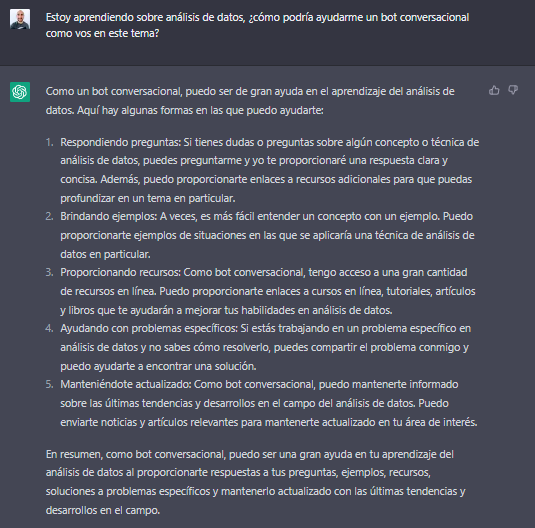
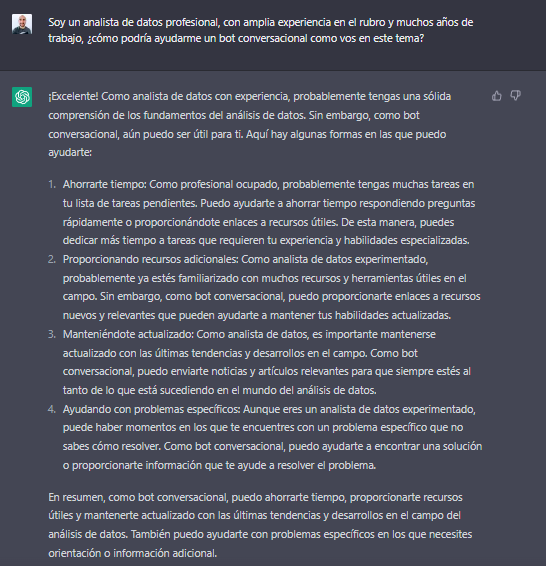
Finally, as far as this book and the solving of activities are concerned, those who want to use these tools (or similar ones) may of course do so at their discretion, without any restriction. However, in pedagogical terms, if they do, it is suggested that their use be accompanied by further reading on the various topics and by written reflections (by the students themselves) on the results obtained. Having these tools presumably saves time, so it ends up being a matter of using the time left over to strengthen learning. In the mandatory assignments their use is also allowed, but students are encouraged to state which tool or tools they used and for what, with a brief description of the process.
Further reading
- Harnessing the Power of ChatGPT for Data Science. Analytics Vidhya, February 2023.
- End-2-End Data Analytics using Open-AI ChatGPT. Kaggle discussion thread.
- How useful is ChatGPT for data visualisation work?. The Data Visualisation Catalogue.